The Asphyx
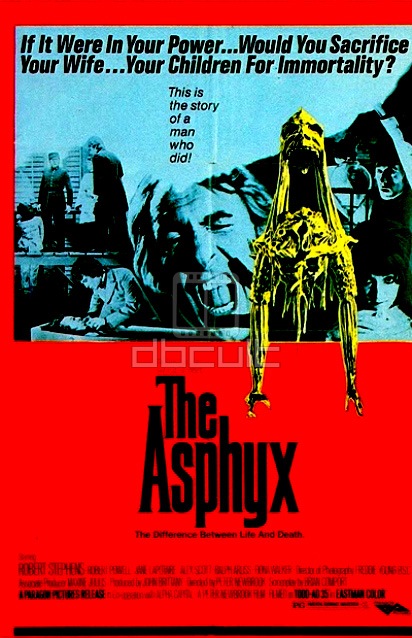
In this horror-fantasy, set during the 19th century, Dr. Stephens discovers that just before a person dies, their body is surrounded by the aura-like Asphyx. In this phenomenon, Stephens believes he sees the key to living forever. When he begins experimenting with humans, he inadvertently releases a terrible supernatural power.
The quest to cheat death is a familiar one in horror fiction, and Sir Hugo Cunningham, the protagonist of The Asphyx, belongs to a long tradition of mad and semi-mad scientists driven to unravel the secret to immortality.
Set in the 1870s, The Asphyx details how Sir Hugo (Robert Stephens), a country squire with interests in photography and parapsychology, discovers the film’s titular spirit. In a series of photographs he and his associates have taken of people as they die, he discovers each features a mysterious smudge seemingly not caused by either faulty equipment or human error. Could these photos depict the soul leaving the human body?
Sir Hugo’s next clue comes as the result of personal tragedy. At a family gathering, he films (using a primitive motion picture camera) a boating accident in which his son Clive drowns. The mysterious smudge appears in the footage, but moving towards Clive, not away from him. Sir Hugo comes to the conclusion that the smudge might be an “asphyx,” a spirit described in Greek mythology that accompanies the souls of the dead to the afterlife.
He finds the final piece of the puzzle when, on behalf of an organization protesting capital punishment, he films a public execution. Using a spotlight of his own devising–the beam filtered through water dripping upon phosphorous crystals–he briefly and accidentally reveals the presence of a spectral figure which appears as the criminal hangs. Reviewing the footage later, Sir Hugo notices two things: first, that the beam of light trapped the figure, believed to be the asphyx; second, that as long as the asphyx remained trapped, the condemned man could not die.
Sir Hugo reasons that if he could somehow summon one’s asphyx (by bringing himself to the point of death), and trap it permanently, that he would never die. Involving his adopted son Giles (Robert Powell) and daughter Christina (Jane Lapotaire) in his experiments, he gains the answers he seeks–but at a terrible price.
Robert Stephens stars in The Asphyx.
The Asphyx is a textbook specimen of vintage British period horror, the sort of films Hammer and Amicus used to make. All of the signature elements of the format are in place. Nobody as familiar as Peter Cushing or Christopher Lee appears, but Stephens and Powell are more than capable of bringing their characters to life. The former portrays Sir Hugo as more down-to-earth and sympathetic than your average mad scientist without sacrificing the obsession; the latter’s take on Giles is a more capable character than most male juvenile leads in this sort of film. Christine is more of a reactive agent in the plot than an active one, but Lapotaire’s performance in the role is better than required.
The film is also chock-full of authentic-seeming (if not actually authentic) period detail. The film’s science is in line with how the “natural philosophers” of the Victorian age thought such things really worked. The interest in spiritual matters reflects the obsessions of the period, and while the asphyx isn’t a real spirit from Greek mythology, the film’s able to pull it off. Some viewers might find certain aspects of the story weird, such as the romance between Christina and her adopted brother Giles.
The production design is superb, filled with vivid detail. The asphyx effect is a bit hokey today, but I expect it was quite effective in the early ’70s. Sir Hugo’s method of trapping asphyxes has an endearingly proto-steampunk feel (and is also reminiscent of the later Ghostbusters).
Sadly, the direction and editing are problematic. Poor editing robs two crucial scenes (Giles’s death and the guillotine sequence) of vital emotional power. There are several highly questionable directorial decisions, such as the choice of footage used when Sir Hugo screens the footage of his son’s death to his peers. And a number of flaws exist in the story–such as the magically teleporting guinea pig and the complete disappearance of Sir Hugo’s fiancée from the story by the end of the first act–that could either be problems with the script or scenes deleted from the final cut.
Contemporary audiences might have accepted such flaws, but the modern viewer might not.
The asphyx revealed.
The Asphyx is, ultimately, an artifact of the time that produced it. It doesn’t have much to offer viewers who aren’t interested in this type of film. However, fans of the format should enjoy it immensely.