Interview with the Manetti Bros. on Their Horror Cinema
When you decided to make a “real” horror film with Paura 3D, what were the elements of the genre that fascinated you the most?
In truth, I think that—for us in particular, but perhaps for any filmmaker—it isn’t really useful to label one’s own film within a specific genre. The most natural path is probably to let that classification come later, from those who watch or review the work. I don’t think our first thought was: "Let’s make a horror movie." We didn’t start from the conventions of the horror genre. We’re directors who, people often say, move across different genres—perhaps precisely because we don’t worry too much about labels. We simply do what the story suggests to us. "Paura" was born from a novel we really loved: "Piano Delta (un blues metropadano)" by Giampiero Rigosi and Guido Leotta. That’s where we started, and then we developed the aspects that interested us most, namely the opening. Everything else is completely different, written by us specifically for the film. For us, deciding to work within horror also meant digging into what truly frightens us: exploring the darkest zones, the blackest thoughts that inhabit us, our anxieties, our deepest fears.
Personally, both during the writing and afterward, I spent many sleepless nights trying to understand what fear really meant to me. It was a very personal process. That’s why I believe it’s important not to be too formal or technical, nor too rigidly bound to genre formulas. Because, in the end, fear—in human beings—follows mechanisms that repeat themselves, but it is always something deeply personal and visceral.
What have been your main influences — directors, films, comics, atmospheres — in shaping the scariest aspects of your horror works? For example, in Paura there are echoes of Bava, Argento, and Fulci.
Up to a certain point in my life, I was very passionate about, and quite well-versed in, the horror genre: I watched countless films, so the influences I carry with me are many, varied, and sometimes hard to define. One great master who profoundly influenced us is without doubt Dario Argento, the true "master of fear." His films have the ability to convey anguish in an almost irrational way, even while telling stories that don’t always belong strictly to horror, but also to the thriller or crime genres. We tried to learn from that lesson, drawing inspiration not only from his films but also from his words. One phrase, in particular, struck us deeply: "Fear is a tightrope balanced between boredom and the ridiculous." This phrase, curious at first glance, actually holds a profound teaching. To create fear, a certain exaggeration, a kind of extremism, is necessary. But pushing too far risks turning anguish into comedy, making horror slip into the ridiculous. On the other hand, the opposite danger is boredom. Fear needs build-up, suspense, silence, ambiguity to work. But if you draw it out too long, the audience loses interest. That’s why it’s crucial to keep that fine line in balance, and in "Paura" we tried to do just that. One example our generation grew up with is John Carpenter’s cult classic "Halloween," which for us remains an absolute masterpiece. Despite being a commercial film, its structure is rare: for much of the running time, "nothing happens," apart from an opening that shows only that the boy is dangerous. From there, it’s a continuous play of suggestion and allusion, leading up to the final killings. Yet the most effective part isn’t the explicit one, but that suspended space of the unspoken. That has always been a huge source of inspiration for us. Besides Argento and Carpenter, we also looked at filmmakers like Sam Raimi and Peter Jackson, who crafted a more irreverent, violent, bloody, and yet ironic kind of horror that never takes itself too seriously. Perhaps it’s less frightening, but it’s incredibly fun. It’s an interesting approach, because often what’s called "gory horror" is actually the most entertaining. Those unfamiliar with the genre tend to think blood is the mark of darker horror, when in fact it often signals a lighter, more playful type. Finally, we also love the great zombie classics, which we’d describe less as horror and more as survival films, since at their core they’re about more than fear—they’re about the struggle to survive. In short, our love for horror is broad: in "Paura" you’ll find both Argento and "Halloween," and from the second half onward, also our passion for more playful, over-the-top horror.
In Paura 3D you experimented with stereoscopy: how challenging was it to use 3D in horror, both from a technical and a narrative perspective?
It’s been many years since that film. At the time, there was a huge interest in 3D: many projects were being made with cameras that had become affordable even for those with limited budgets, making experimentation possible. For us, it was mainly a technical challenge: we wanted to try, to see how far we could go. It was a fun experience, and some of the solutions we came up with still satisfy us today. Looking back, I don’t know if I would make it in 3D again. As was predictable, this technology had several "lives," but all of them very short: moments of enthusiasm quickly followed by decline. What I truly regret is that today it’s difficult to see the film as it was conceived and made in 3D, and that saddens me. Even so, it remains a valuable experience, though a very demanding one, both during shooting and, especially, in post-production. We tried to give 3D our own narrative purpose. Up to that point, it was often used to wow audiences with spectacular effects, with objects "coming out of the screen." We too inserted a couple of shots like that—for instance, at the beginning, with a stake that seems to jut right toward the viewer. But personally, I believe 3D is much more interesting when it’s used for depth. In that sense, it was perfect for that film: much of the story takes place in a cramped basement, and 3D helped convey that claustrophobic, mysterious feeling. If the technique added value anywhere, it was precisely in those cellar sequences.
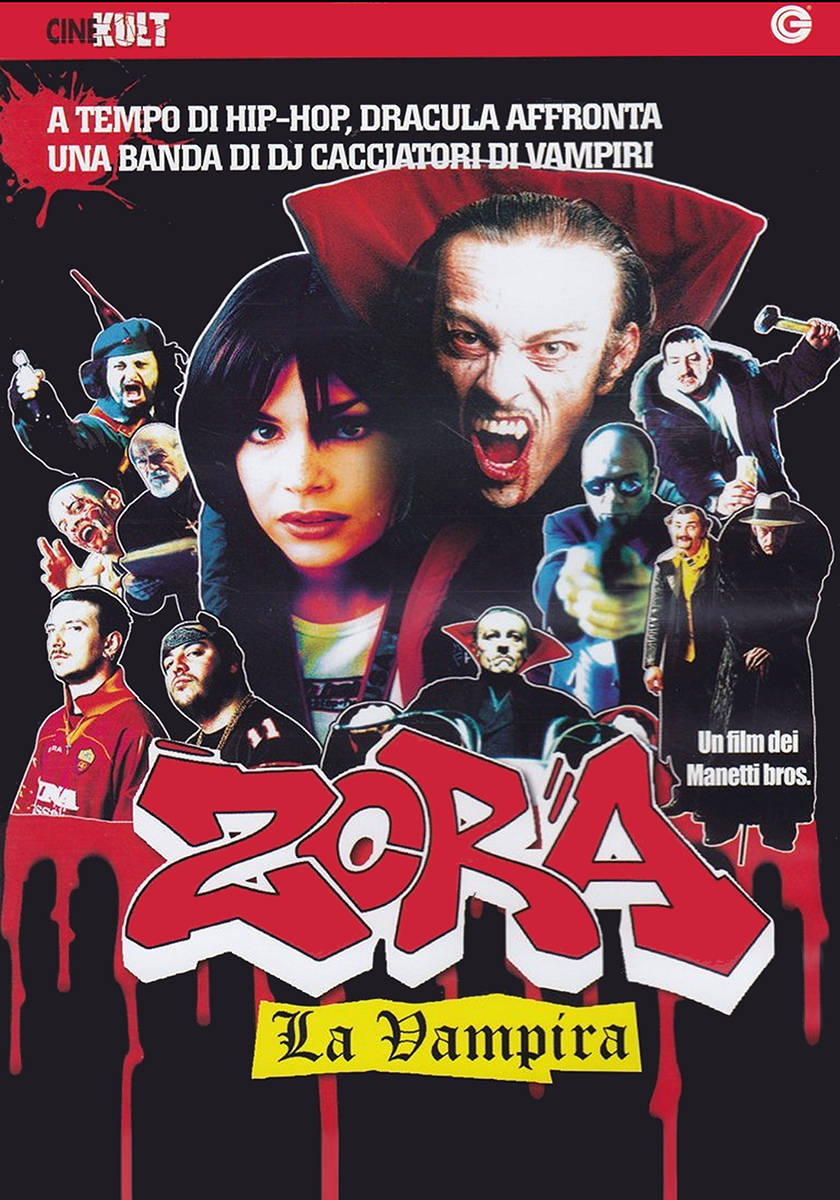
The line between pure horror and horror-comedy is often thin: how do you approach these crossovers? I’m thinking of Zora the Vampire or The Crypt Monster, where there are ironic or nostalgic elements. How do you balance fear with humor or fantasy?
I don’t know exactly why, but I think fear and comedy are two emotions closely connected. Perhaps because they represent the extremes of emotional experience: pathos is intense, certainly, but fear and comedy have an immediate, radical effect. With fear, you turn away; with comedy, you laugh. They’re sharp, precise emotions, and sometimes they can coexist and balance each other. One example is "Il mostro della cripta," which we wrote and produced. At first it was meant to be directed by us, but we eventually entrusted it to Daniele Misischia. Our approach there was different from "Zora the Vampire." The latter is pure comedy, with a parodic tone, a modern Italian reinterpretation of the Dracula myth. Since I’m a big Dracula enthusiast, though, some of the scenes featuring him are darker, closer to true horror. With "Il mostro della cripta," instead, we wanted to create a horror adventure, while still keeping comedic tones. Balancing these two emotions isn’t easy: often a film chooses one path only—to make you laugh or to scare you. Very few manage to keep both. But when it works, the result is truly special. Two almost perfect examples come to mind: Peter Jackson’s "The Frighteners," which alternates moments of pure comedy with scenes of genuine terror, and Sam Raimi’s "The Evil Dead," where the mix of fear and comedy reaches an extraordinary equilibrium. It’s rare and difficult, but when it succeeds, it’s wonderful.
In your horror films you often feature very distinctive actors. How do you choose the cast? Do you rely more on the character as written, or on the energy the actor brings?
I can tell you the principle we follow when choosing actors for our films. When we write a script—or even when we read stories not written by us—we always begin by focusing on the characters. We analyze them, discuss them together, and try to understand what kind of person they are, imagining which actor could portray them best. Our first thought usually goes to someone we already know, an actor whose past performances have reminded us of that idea of the character. In a sense, we look for the actor who resembles the initial idea of the character. But it’s important to remember that actors are real people, and that’s both the limitation and the beauty of cinema: it’s not like animation, where you can draw exactly what you want. The actor will inevitably bring something of their own to the character: gestures, emotions, nuances. They may take away something you imagined, but they’ll also give you unexpected aspects. At a certain point, the character is no longer just yours: it becomes theirs. A director’s skill also lies in accepting this process, in letting go. Because cinema is a collective art: at a certain point, the actor takes ownership of the character. Some directors are very demanding, trying to control every detail, but we prefer to trust the actor, to let them truly become the character. Of course, there must be oversight. A film doesn’t rely on a single character: a character lives within the story. That’s why it’s essential that certain traits, reactions, and emotions remain consistent with the narrative. Sometimes actors risk "overdoing it," pulling the character too far into personal territory, forgetting the role they play within the plot. In horror, this aspect is even more delicate. For instance, if the audience is supposed to fear for a character’s fate, but the actor plays them like an invincible Schwarzenegger-style hero—strong, omnipotent, indestructible—then the sense of tension is lost. That’s why even a tough character must reveal their fragility at the right moments. That fragility is what makes them believable, and it’s exactly what the story needs at that point.
In The End? The Apocalypse Outside you were producers, not directors: how does your perspective on horror change when you’re not behind the camera?
That’s a very interesting question, one we care a lot about, because we realized that when a director also becomes a producer, they inevitably carry their directorial background with them. This background can manifest in two ways. The most common case—and one that often surprises the directors we work with, when they discover we don’t behave this way—is interference. There are often producer-directors who end up imposing their hand, their style, even on films directed by others. Famous examples exist: think of "My Name is Nobody," directed by Tonino Valerii but produced by Sergio Leone. That film was forever marked by this dynamic: Valerii himself felt the frustration of seeing the work perceived as "too much in Leone’s style." We’ve always tried to do the opposite. When producing, we try to be the kind of producer we’d want as directors: maintaining a clear distinction between the two roles, never trying to direct in someone else’s place. Our goal is to support the director’s vision, not replace it.This approach has worked very well, especially within horror productions. Examples include "Bed No. 6," directed by our longtime collaborator Milena Cocozza; "The End? L’inferno fuori" and "Il mostro della cripta," the latter mixing horror and comedy, both directed by Daniele Misischia. It also worked with "The War of Tiburtino III" by Luna Gualano, a sci-fi film with strong comedic undertones. In this case, we commissioned the screenplay and produced it, creating a project we’re very proud of, which was selected at the Rome Film Festival. Of course, this doesn’t mean we simply go along with everything. Being producers also means making decisions: demanding certain things, rejecting others, pushing when necessary. But we always do so with the awareness that the work belongs to the director. Our task is to ensure that their vision remains intact, helping them to bring it to life. Of course, if you choose the wrong director and force them to do something they don’t feel, that doesn’t fit their sensibilities, the risk is great. But if a relationship of trust is built, then the producer can truly become a precious ally. In this sense, rather than "director-producers," we like to call ourselves producers who deeply understand the needs of a director, and who try to act accordingly.
If you had to pick a favorite horror film, which one would you choose and why?
That’s not an easy question. I can list a few films, but I already know I’ll regret not mentioning others later: neither my brother nor I are the type for rankings. So inevitably, this answer will be very personal. Rather than "favorite films," I’d say they’re generational films, tied to a specific time in our lives. You become attached to the films you see in youth, when certain emotions mark you in an indelible way. For example, thinking of Dario Argento, whom I consider the master of horror, the title I’d mention isn’t necessarily his best film, but the one that mattered most to me: "Inferno." It was the first Argento I saw in a theater, even though it was forbidden to under-14s and I hadn’t reached that age yet. I sneaked in, pretending to be older, and it was an unforgettable experience. For that reason, it remains my Argento film of the heart, even if I wouldn’t call it his absolute masterpiece. Then there are other essential titles: "Halloween," already mentioned, "The Evil Dead," and "The Texas Chainsaw Massacre," which we particularly love. Looking further back, to a generation before ours, you can’t fail to mention "Psycho": a film that truly terrifies, and one that remains incredibly important to us. So, your question is almost impossible: I’ve mentioned these films not because they’re the best of all time, but because they’re tied to specific moments in my life, for reasons that are above all generational.
How do you see contemporary horror cinema today, both in Italy and internationally? Are there new trends or directors you’re particularly excited about?
As for contemporary horror, we’re not very up-to-date—since we work a lot—but horror still fascinates us, and there are truly interesting directors and films out there. It’s a good period for the genre: for us, it represents an important historical moment, because this new generation of young directors—even younger than us—has finally overcome all barriers. Horror today has become auteur cinema in its own right. This is what is often called "elevated horror": films that win awards at festivals, praised by critics, often controversial, innovative, and experimental. This kind of horror is very interesting, though it probably still needs to find its full balance. Regarding Italian horror, the situation seems a bit more dramatic. There are many attempts and some films more interesting than ten years ago, but in our opinion the "great film" is still missing. The national scene, therefore, isn’t in the best condition, whereas internationally, truly stimulating projects are emerging. Among the directors we follow closely, Jordan Peele is without a doubt one of the most brilliant. "Get Out" enlightened us: it combines unease, comedy, and social themes in an unparalleled way. Peele blends horror and irony into serious, unsettling films, and this style is very close to us—we appreciate it immensely. Other interesting names include Robert Eggers, with films like "The Lighthouse" and "Nosferatu", and Ari Aster, author of "Midsommar". These directors belong to the phenomenon of auteur horror and confirm that, on an international level, the genre is experiencing a very encouraging season. Unfortunately, on the national level, the situation remains more complex.
What role does the Italian audience play in your horror films? Do you think there is a specific sensibility, tradition, or expectation in Italy that influences your choices — for instance in the level of violence shown, the use of myth or folklore, or in urban vs. rural settings?
As for the relationship with the audience, I believe that an author—and the same goes for a producer—must feel it, not chase it. There’s nothing I would do "to please" the audience. Whenever I hear things like: "Now would be the right time to do this… the audience is asking for that…", my answer is always the same: what do I know? You get to know the audience by living it, by being a spectator yourself, by watching films, by living in the present. I don’t think there are rules or precise guidelines to follow—absolutely not. What I do believe, however, is that in Italy the idea of "elevated horror" hasn’t really developed yet—that is, bringing personality, originality, and auteurship into the genre. Some attempts have been made: Luca Guadagnino with "Suspiria" and "Bones and All" tried, perhaps he was the only one, but in my view not completely successfully. The problem is that in Italy there’s still a clear division: on one side, those who see themselves as "auteurs" and reject the idea of including genre elements in their films; on the other side, those who see themselves as genre directors and keep looking back to the ’60s and ’70s, to the old commercial trash horror. Today, instead, I see many young directors who are both passionate about horror and potential auteurs. And that’s the real challenge: managing to combine the two souls. For now, though, attempts don’t go all the way: either a film leans too heavily toward auteur cinema and denies being horror, or it only speaks to hardcore fans, limiting itself with narrow choices. I repeat: in some way, Guadagnino was the only one to attempt something bolder, but we’re still waiting for a true balance.
Looking ahead: which horror themes would you like to explore that you haven’t tackled yet? Is there a subject, mythos, or horror sub-genre that particularly intrigues you for a future project?
Reaffirming that we never really think in terms of genres, I can tell you which projects we’d like to realize in our career. Someone, afterward, might categorize them as horror, but that’s not how we think: we don’t say to ourselves, "Now let’s make a ghost movie." That’s not our way of working. As directors, we’ve realized that the darker side isn’t exactly our main focus: often we prefer to produce it rather than direct it. That said, we don’t rule out returning to it in the future, exploring those darker zones again. One project we’d like to tackle sooner or later has to do with a teenage passion of ours: Lovecraft. He’s an author we love deeply and grew up with—both as readers and as role-players with "Call of Cthulhu". His universe is horrifying, sci-fi, and profoundly unsettling—an atmosphere cinema has attempted many times, but never really captured in all its power. We’ve already worked on a screenplay based on the story "The Whisperer in Darkness", written together with a group of students, and the result was very good. But we’d also like to adapt other texts, like "The Call of Cthulhu" itself: a story that is narratively "truncated," unusual and peculiar, but filled with incredible suggestions. We’re also fascinated by stories with Lovecraftian influences contaminated with elements of comedy. These are universes and languages we’d love to explore, and they’re among the "darkest" themes we hope one day to bring to the screen... then, of course, many other things can happen.
MOMPRACEM WEBSITE